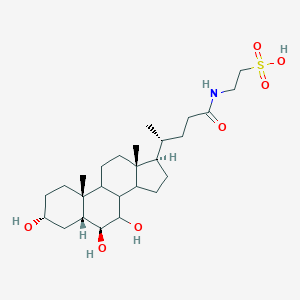
General Information of MET (ID: META00347)
Name Tauro-beta-muricholic acid
Synonyms   Click to Show/Hide Synonyms of This Metabolite
N-(3a,6b,7b-Trihydroxy-5b-cholan-24-oyl)-taurine; T-alpha-MC; T-beta-MC; Tauro-alpha-muricholate; Tauro-alpha-muricholic acid; Tauro-b-muricholate; Tauro-beta-muricholate; Tauro-beta-muricholic acid; Tauromuricholate; Tauromuricholic acid
Source Endogenous;Food
Structure Type   Bile acids, alcohols and derivatives  (Click to Show/Hide the Complete Structure Type Hierarchy)
Lipids and lipid-like molecules
Steroids and steroid derivatives
Bile acids, alcohols and derivatives
PubChem CID
168408
HMDB ID
HMDB0000932
Formula
C26H45NO7S
Structure
<iframe style="width: 300px; height: 300px;" frameborder="0" src="https://embed.molview.org/v1/?mode=balls&cid=168408"></iframe>
3D MOL 2D MOL
  Click to Show/Hide the Molecular/Functional Data (External Links/Property/Function) of This Metabolite
FooDB ID
FDB022322
ChemSpider ID
147312
METLIN ID
5881
Physicochemical Properties Molecular Weight 515.7 Topological Polar Surface Area 153
XlogP 2.6 Complexity 891
Heavy Atom Count 35 Rotatable Bond Count 7
Hydrogen Bond Donor Count 5 Hydrogen Bond Acceptor Count 7
Function
Tauro-b-muricholic acid is a bile acid. Bile acids are steroid acids found predominantly in the bile of mammals. The distinction between different bile acids is minute, depending only on the presence or absence of hydroxyl groups on positions 3, 7, and 12. Bile acids are physiological detergents that facilitate excretion, absorption, and transport of fats and sterols in the intestine and liver. Bile acids are also steroidal amphipathic molecules derived from the catabolism of cholesterol. They modulate bile flow and lipid secretion, are essential for the absorption of dietary fats and vitamins, and have been implicated in the regulation of all the key enzymes involved in cholesterol homeostasis. Bile acids recirculate through the liver, bile ducts, small intestine and portal vein to form an enterohepatic circuit. They exist as anions at physiological pH and, consequently, require a carrier for transport across the membranes of the enterohepatic tissues. The unique detergent properties of bile acids are essential for the digestion and intestinal absorption of hydrophobic nutrients. Bile acids have potent toxic properties (e.g. membrane disruption) and there are a plethora of mechanisms to limit their accumulation in blood and tissues.
Regulatory Network
Full List of Protein(s) Regulating This Metabolite
      Apolipoprotein (Apo)
            Apolipoprotein A-II (APOA2) Click to Show/Hide the Full List of Regulating Pair(s):   1 Pair(s)
               Detailed Information Protein   Info click to show the details of this protein
               Regulating Pair Experim Info click to show the details of experiment for validating this pair [1]
                      Introduced Variation Mutation (-265T >C(rs5082)) of APOA2
                      Induced Change Tauro-beta-muricholic acid concentration: decrease (FC = 0.06)
                      Summary Introduced Variation         Induced Change 
                      Disease Status Obesity [ICD-11: 5B81]
                      Details It is reported that mutation (-265T >C(rs5082)) of APOA2 leads to the decrease of tauro-beta-muricholic acid levels compared with control group.
      Transferases (EC 2)
            Pyrophosphate geranylgeranyl synthase (GGPS1) Click to Show/Hide the Full List of Regulating Pair(s):   1 Pair(s)
               Detailed Information Protein   Info click to show the details of this protein
               Regulating Pair Experim Info click to show the details of experiment for validating this pair [2]
                      Introduced Variation Knockout of Ggps1
                      Induced Change Tauro-beta-muricholic acid concentration: decrease
                      Summary Introduced Variation         Induced Change 
                      Disease Status Metabolic liver disease [ICD-11: 5C90]
                      Details It is reported that knockout of Ggps1 leads to the decrease of tauro-beta-muricholic acid levels compared with control group.
References
1 Epigenomics and metabolomics reveal the mechanism of the APOA2-saturated fat intake interaction affecting obesity. Am J Clin Nutr. 2018 Jul 1;108(1):188-200.
2 Conditional loss of geranylgeranyl diphosphate synthase alleviates acute obstructive cholestatic liver injury by regulating hepatic bile acid metabolism. FEBS J. 2020 Aug;287(15):3328-3345.

If you find any error in data or bug in web service, please kindly report it to Dr. Zhang and Dr. Mou.