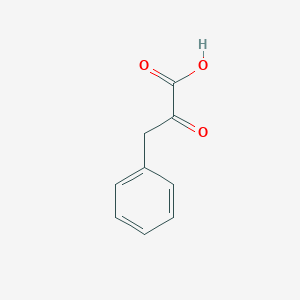
General Information of MET (ID: META00202)
Name Phenylpyruvic acid
Synonyms   Click to Show/Hide Synonyms of This Metabolite
2-Oxo-3-phenylpropanoate; 2-Oxo-3-phenylpropanoic acid; 2-Oxo-3-phenylpropionic acid; 3-PHENYLPYRUVate; 3-Phenyl-2-oxopropanoate; 3-Phenyl-2-oxopropanoic acid; 3-Phenyl-2-oxopropionic acid; 3-Phenylpyruvic acid; FEMA 3892; Keto-phenylpyruvate; Phenylbrenztraubensaeure; Phenylpyruvate; Phenylpyruvic acid; a-Hydroxycinnamic acid; a-Ketohydrocinnamate; a-Ketohydrocinnamic acid; a-Oxo-benzenepropanoate; a-Oxo-benzenepropanoic acid; alpha-Ketohydrocinnamic acid; alpha-Oxo-benzenepropanoic acid; alpha-Oxobenzenepropanoic acid; b-Phenylpyruvate; b-Phenylpyruvic acid; beta-Phenylpyruvic acid; keto-Phenylpyruvic acid
Source Endogenous;Escherichia Coli Metabolite;Yeast Metabolite;Food;Drug;Food additives;Microbial
Structure Type   Phenylpyruvic acid derivatives  (Click to Show/Hide the Complete Structure Type Hierarchy)
Benzenoids
Benzene and substituted derivatives
Phenylpyruvic acid derivatives
PubChem CID
997
HMDB ID
HMDB0000205
Formula
C9H8O3
Structure
<iframe style="width: 300px; height: 300px;" frameborder="0" src="https://embed.molview.org/v1/?mode=balls&cid=997"></iframe>
3D MOL 2D MOL
  Click to Show/Hide the Molecular/Functional Data (External Links/Property/Function) of This Metabolite
KEGG ID
C00166
DrugBank ID
DB03884
ChEBI ID
30851
FooDB ID
FDB008272
ChemSpider ID
972
METLIN ID
328
Physicochemical Properties Molecular Weight 164.16 Topological Polar Surface Area 54.4
XlogP 1.3 Complexity 180
Heavy Atom Count 12 Rotatable Bond Count 3
Hydrogen Bond Donor Count 1 Hydrogen Bond Acceptor Count 3
Function
Phenylpyruvic acid is a keto-acid that is an intermediate or catabolic byproduct of phenylalanine metabolism. It has a slight honey-like odor. Levels of phenylpyruvate are normally very low in blood or urine. High levels of phenylpyruvic acid can be found in the urine of individuals with phenylketonuria (PKU), an inborn error of metabolism. PKU is due to lack of the enzyme phenylalanine hydroxylase (PAH), so that phenylalanine is converted not to tyrosine but to phenylpyruvic acid. In particular, excessive phenylalanine can be metabolized into phenylketones through, a transaminase pathway route involving glutamate. Metabolites of this transamination reaction include phenylacetate, phenylpyruvate and phenethylamine. In persons with PKU, dietary phenylalanine either accumulates in the body or some of it is converted to phenylpyruvic acid. Individuals with PKU tend to excrete large quantities of phenylpyruvate, phenylacetate and phenyllactate, along with phenylalanine, in their urine. If untreated, mental retardation effects and microcephaly are evident by the first year along with other symptoms which include: unusual irritability, epileptic seizures and skin lesions. Hyperactivity, EEG abnormalities and seizures, and severe learning disabilities are major clinical problems later in life. A "musty or mousy" odor of skin, hair, sweat and urine (due to phenylacetate accumulation); and a tendency to hypopigmentation and eczema are also observed. The neural-development effects of PKU are primarily due to the disruption of neurotransmitter synthesis. In particular, phenylalanine is a large, neutral amino acid which moves across the blood-brain barrier (BBB) via the large neutral amino acid transporter (LNAAT). Excessive phenylalanine in the blood saturates the transporter. Thus, excessive levels of phenylalanine significantly decrease the levels of other LNAAs in the brain. But since these amino acids are required for protein and neurotransmitter synthesis, phenylalanine accumulation disrupts brain development, leading to mental retardation. Phenylpyruvic acid is also a microbial metabolite, it can be produced by Lactobacillus plantarum.
Regulatory Network
Full List of Protein(s) Regulating This Metabolite
      Apolipoprotein (Apo)
            Apolipoprotein A-II (APOA2) Click to Show/Hide the Full List of Regulating Pair(s):   1 Pair(s)
               Detailed Information Protein   Info click to show the details of this protein

               Regulating Pair Experim Info click to show the details of experiment for validating this pair [1]
                      Introduced Variation Mutation (-265T >C(rs5082)) of APOA2
                      Induced Change Phenylpyruvic acid concentration: decrease (FC = 0.74)
                      Summary Introduced Variation         Induced Change 
                      Disease Status Obesity [ICD-11: 5B81]
                      Details It is reported that mutation (-265T >C(rs5082)) of APOA2 leads to the decrease of phenylpyruvic acid levels compared with control group.
References
1 Epigenomics and metabolomics reveal the mechanism of the APOA2-saturated fat intake interaction affecting obesity. Am J Clin Nutr. 2018 Jul 1;108(1):188-200.

If you find any error in data or bug in web service, please kindly report it to Dr. Zhang and Dr. Mou.