| General Information of MET (ID: META00856) |
| Name |
Gamma-Glutamylalanine
|
| Synonyms |
Click to Show/Hide Synonyms of This Metabolite
5-L-Glutamyl-L-alanine; 5-L-Glutamylalanine; L-gamma-Glu-L-ala; L-gamma-Glutamyl-L-alanine; N-L-g-Glutamyl-L-alanine; N-L-gamma-Glutamyl-L-alanine; N-L-gamma-Glutamylalanine; N-gamma-Glutamylalanine; N-gamma-L-Glutamyl-L-alanine; g-Glutamylalanine; g-L-Glutamyl-L-alanine; gamma-Glu-Ala; gamma-Glutamylalanine; gamma-L-Glu-L-Ala; gamma-L-Glutamyl-L-alanine
|
| Source |
Endogenous;Yeast Metabolite;Food;Microbial
|
| Structure Type |
Amino acids, peptides, and analogues (Click to Show/Hide the Complete Structure Type Hierarchy)
Organic acids and derivatives
Carboxylic acids and derivatives
Amino acids, peptides, and analogues
|
| PubChem CID |
|
| HMDB ID |
|
| Formula |
C8H14N2O5
|
| Structure |
<iframe style="width: 300px; height: 300px;" frameborder="0" src="https://embed.molview.org/v1/?mode=balls&cid=440103"></iframe>
|
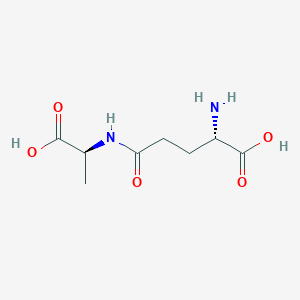 |
|
3D MOL
|
2D MOL
|
|
Click to Show/Hide the Molecular/Functional Data (External Links/Property/Function) of This Metabolite
|
| KEGG ID |
|
| ChEBI ID |
|
| FooDB ID |
|
| ChemSpider ID |
|
| Physicochemical Properties |
Molecular Weight |
218.21 |
Topological Polar Surface Area |
130 |
| XlogP |
-3.8 |
Complexity |
266 |
| Heavy Atom Count |
15 |
Rotatable Bond Count |
6 |
| Hydrogen Bond Donor Count |
4 |
Hydrogen Bond Acceptor Count |
6 |
| Function |
gamma-Glutamylalanine is a dipeptide composed of gamma-glutamate and alanine, and is a proteolytic breakdown product of larger proteins. It belongs to the family of N-acyl-alpha amino acids and derivatives. These are compounds containing an alpha amino acid which bears an acyl group at its terminal nitrogen atom. gamma-Glutamylalanine is a natural substrate of the enzyme (5-L-glutamyl)-L-amino acid 5-glutamyltransferase (cyclizing) (g-glutamylcyclotransferase, EC 2.3.2.2) in the glutathione metabolism pathway, which cleaves gamma-glutamylalanine to produce L-5-oxoproline. gamma-Glutamylcyclotransferase is widely distributed in both human and animal tissues where it catalyzes the scission of the y-peptide bonds of many different gamma-glutamyl-amino acids and gamma-glutamyl-gamma-glutamyl-amino acids. The latter are 'better' substrates of the enzyme than the corresponding gamma-glutamyl-amino acids.
|
|
Regulatory Network
|
|
|
|
|
|
|
|
|

 click to show the details of this protein

 Induced Change